Screen Printing Minimums: If you’ve ever reached out to a screen printing shop asking for a handful of custom shirts and gotten hit with a “sorry, we have a 12-piece minimum,” you’re not alone. It’s one of the most common points of confusion for first-time buyers, and honestly, it’s a fair question. Why can’t you just order two shirts? The answer comes down to how screen printing actually works, and once you understand the process, the minimum makes complete sense.
What a Screen Printing Minimum Order Actually Means
Before getting into the why, it helps to be clear on what a screen printing minimum order quantity (MOQ) is in the context of screen printing. An MOQ is simply the lowest number of pieces a shop will accept for a single print job. It is not about garment inventory or supplier rules. It is about the production economics of setting up a screen print run.
The Difference Between Per-Piece Cost and Setup Cost
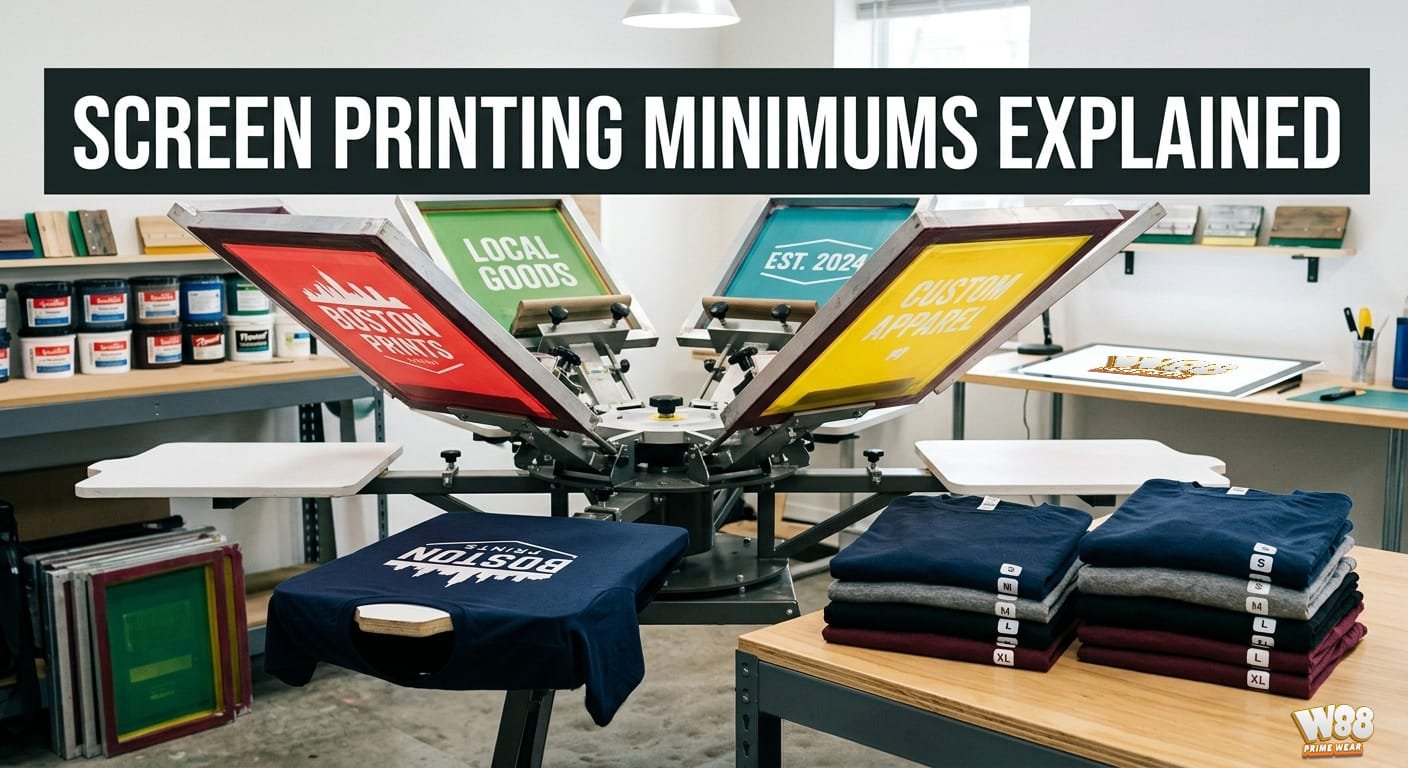
When you place a screen printing order, two very different types of costs are at play. One is the per-piece print cost, which scales down as your quantity goes up. The other is the setup cost, which stays the same whether you print 12 shirts or 500. Screen setup at W88 Prime Wear runs $15.00 per screen for new orders ($10.00 for exact reorders). A two-color design means two screens, so $30.00 in setup before a single shirt comes off the press. Spread across 200 shirts, that’s basically nothing per piece. Spread across 2 shirts, it’s $15.00 each before printing even starts.
Prices reflect print labor only and do not include the cost of garments.
Why the Setup Process Is Always the Same Length
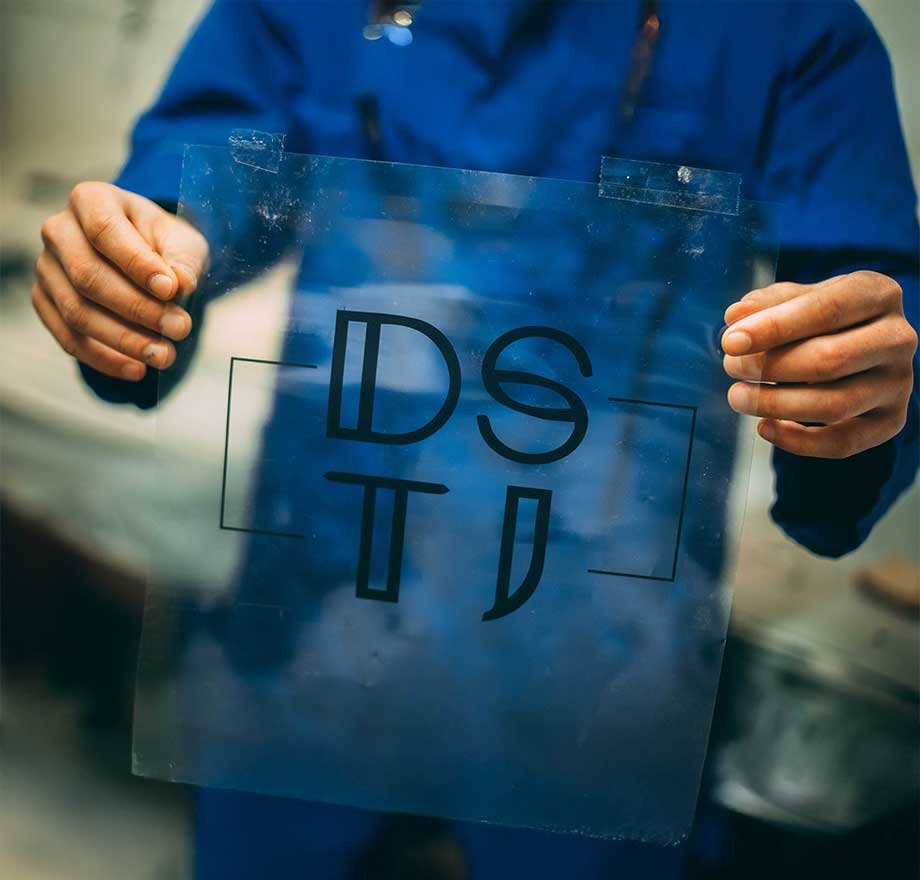
Here is the part that surprises most people. The time it takes to prepare a screen printing job does not shrink when the order is small. Art separation, film output, screen coating, exposure, washout, press registration, ink mixing, and a test print all have to happen regardless of quantity. Whether you want 6 shirts or 600, that production prep looks exactly the same from the shop’s side. The only thing that changes is how many pieces absorb that fixed cost. Smaller orders carry a heavier per-unit burden, which is precisely why printing 6 shirts under the standard minimum doubles the per-piece rate at W88 Prime Wear.
How Color Count Changes the Equation
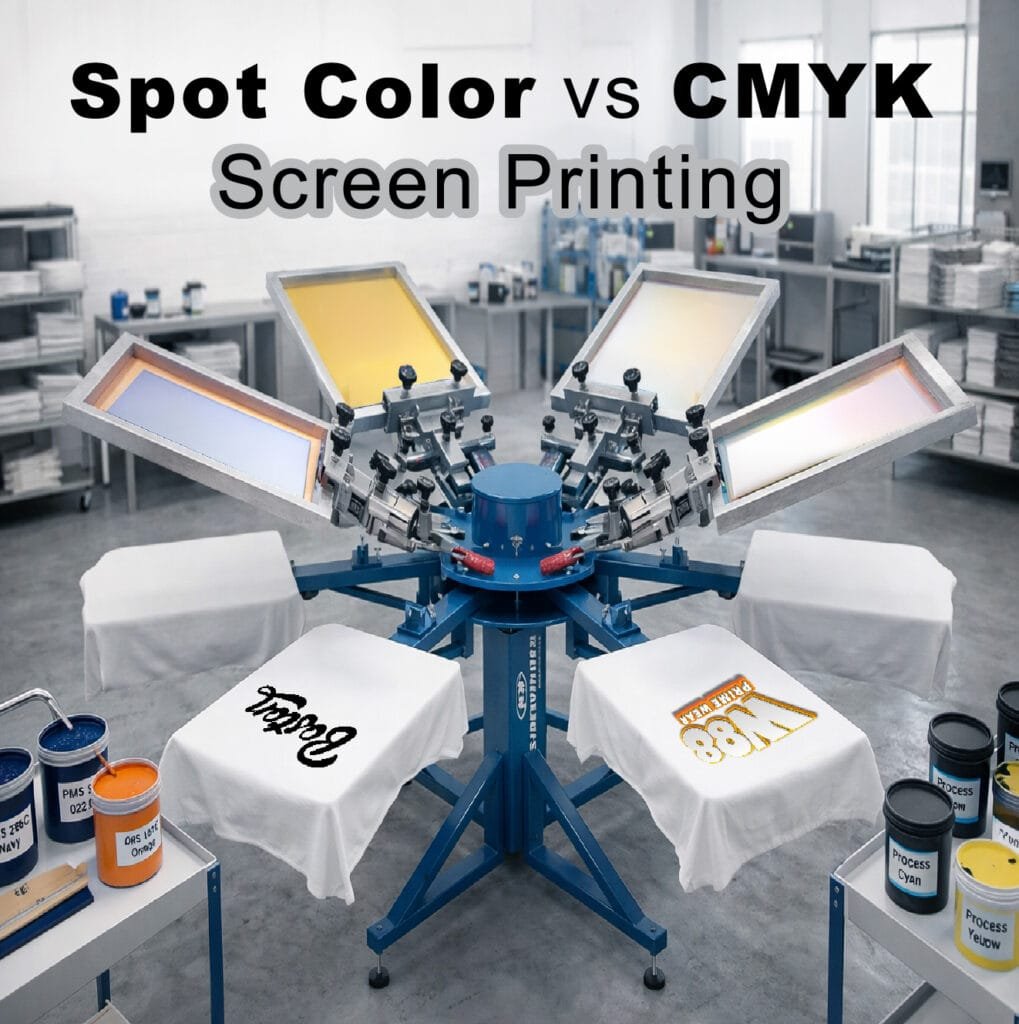
The number of ink colors in your design directly affects how many screens need to be burned, which changes both the setup cost and the minimum that makes economic sense. A simple one-color design is far more forgiving in terms of minimums because there is only one screen to prepare and register. A four-color design requires four screens, four rounds of registration, and four separate ink setups before a single good shirt is produced. The more colors involved, the more the fixed costs stack up, and the more pieces you need to spread them across before the per-unit price becomes reasonable.
The Real Economics Behind the 12-Piece Standard
Most screen printing shops land somewhere around 12 to 24 pieces as their standard minimum, and this is not arbitrary. It reflects a fairly universal calculation around what it takes for a job to be worth setting up at all.
Breaking Down the Fixed Costs of a Typical Job
Take a simple two-color design. At W88 Prime Wear, screen setup runs $30.00 total for two new screens. Add even a small amount of artwork preparation time at $45.00 per hour, and before anyone touches a shirt, you’re already looking at meaningful fixed costs. Now divide those costs across just 6 shirts. The per-shirt burden becomes significant before you even factor in ink, press time, or the garment itself. At 24 or 48 pieces, that same fixed cost shrinks to a fraction of a dollar per shirt, and the overall pricing becomes genuinely competitive.
What Happens Below the Minimum
At W88 Prime Wear, orders under 12 pieces are possible, but they’re priced at double the standard per-piece rate. That is not a penalty; it’s an honest reflection of what it actually costs to run the job. The press still needs to be set up, the screens still need to be burned, and the press operator still needs to run calibration prints before the good shirts start coming through. That labor is real regardless of how small the order is. Because W88 Prime Wear handles everything in-house without outsourcing to third-party printers, there are no middleman markups in that calculation. What you pay reflects the actual cost of production.
Where Quantity Breaks Start to Work in Your Favor
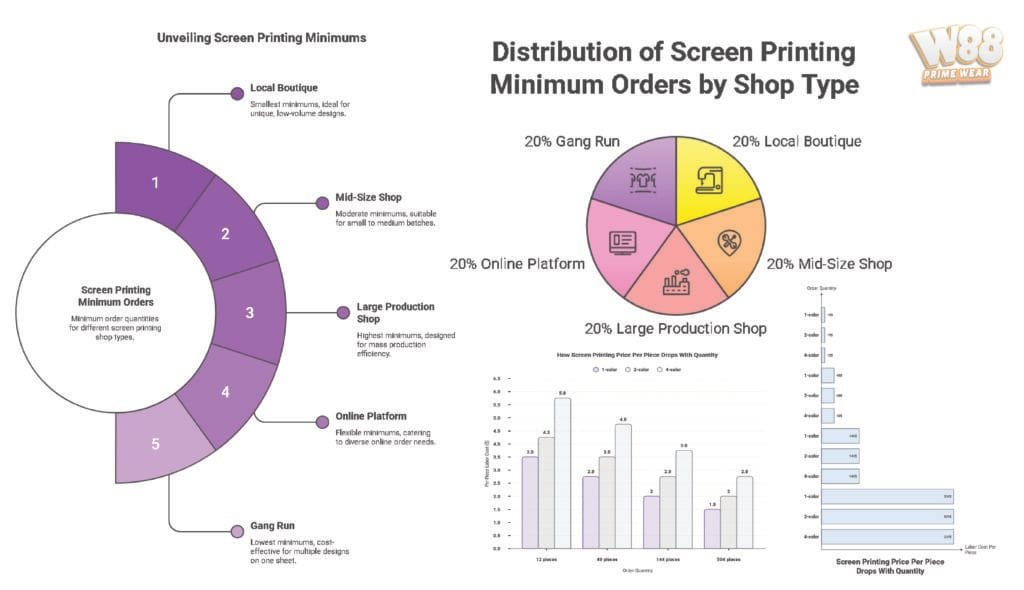
Screen printing rewards volume more clearly than almost any other print method. Here is how the per-piece print pricing shifts at W88 Prime Wear for a one-color print (labor only, garments not included):
| Quantity | 1 Color | 2 Colors | 3 Colors | 4 Colors |
|---|---|---|---|---|
| 12 pcs | $2.69 | $3.96 | $5.23 | $6.50 |
| 48 pcs | $1.32 | $2.15 | $2.98 | $3.81 |
| 144 pcs | $0.90 | $1.23 | $1.56 | $1.89 |
| 288 pcs | $0.70 | $0.99 | $1.28 | $1.57 |
| 504 pcs | $0.55 | $0.75 | $0.87 | $1.04 |
Prices reflect print labor only and do not include the cost of garments.
The difference between 12 and 144 pieces on a one-color print is more than $1.75 per shirt in labor alone. On a bulk order for a school, team, or marketing campaign, that spread adds up fast.
What to Expect When You Place an Order
Knowing the minimum exists is one thing. Knowing what the ordering experience actually looks like is another, and first-time buyers often have more questions about the process than the pricing.
How Minimums Apply Across Sizes and Garment Styles
One thing that catches people off guard: the minimum typically applies to the total piece count per design, not per size. If you need 3 smalls, 4 mediums, 3 larges, and 2 XLs, that is a 12-piece order and it qualifies. You do not need 12 of each size. However, if you want the same design printed on a different garment style (say, a crewneck sweatshirt and a T-shirt), those are generally treated as separate setups because the press configuration and platen size can differ. It is always worth confirming with the shop upfront.
Rush Orders and Turnaround Time
Standard turnaround at most shops, including W88 Prime Wear, runs around 7 to 10 business days from art approval to completion. If you need it faster, a rush charge of 25% is added to the total order price. The rush option is available when the production schedule allows for it, so it is not guaranteed. The more lead time you give, the smoother the experience, especially for multi-color designs that require more press setup time. Planning ahead almost always saves money.
What Alternatives Exist for Truly Small Orders
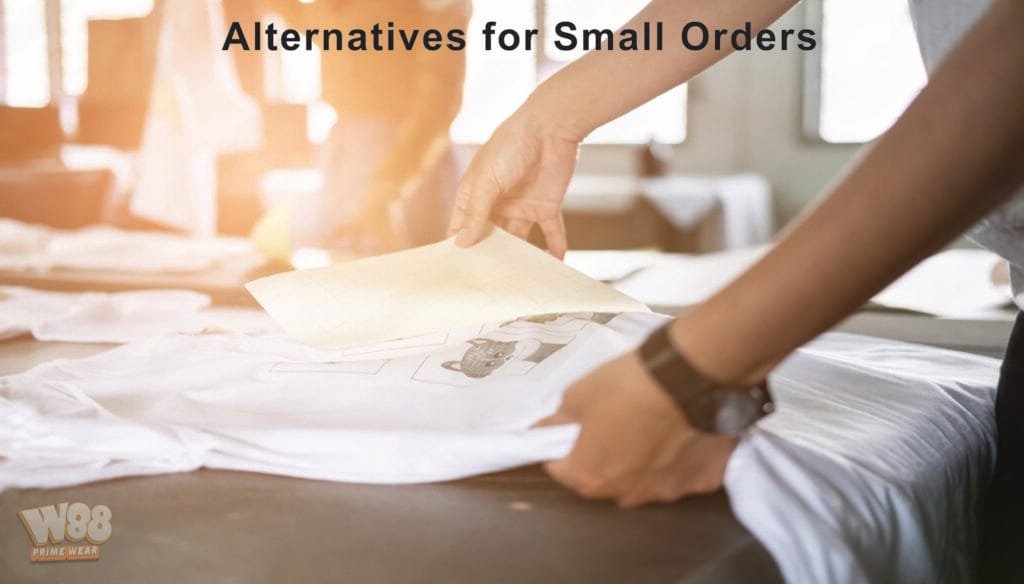
If your quantity genuinely falls under what screen printing can accommodate economically, there are other methods worth knowing about. Heat transfer and DTF (direct-to-film) printing carry much lower or no minimums, and they are a strong fit for short runs or designs with high color complexity. The tradeoff is durability and feel: screen printing ink bonds into the fabric fibers and holds up through heavy washing, while transfers and DTF prints sit on top of the garment surface and can show wear over time. For branded merchandise you want to last, screen printing at the right quantity is still the benchmark for quality.
Tips for Making the Most of Your Order
Whether you are a small business ordering branded shirts for the first time or a marketing agency managing a campaign run, a few practical moves can stretch your screen printing budget further.
Here are the most useful things to keep in mind before you place your order:
- Consolidate sizes into a single order rather than splitting across multiple small runs.
- Limit your color count to two or three colors when possible to keep screen costs down.
- Plan your quantity at a break point (48, 96, 144) to capture a meaningful price reduction.
- Order a few extras upfront since reprinting a handful of shirts later will cost more per piece than adding them to the original run.
- Have your art file ready in vector format to avoid design prep charges.
- Reorder the exact same design to qualify for the $10.00 per screen reorder rate instead of the new screen price.
- Confirm garment availability before finalizing your design color, since certain ink colors require specific shirt colors to print accurately.
Final Thoughts
Screen printing minimums exist because the process has real, fixed costs that do not disappear just because the order is small. Once you understand where those costs come from, the minimums stop feeling like a barrier and start feeling like a natural feature of how the process works. The economics actually favor you as your quantity grows, which is why screen printing remains one of the most cost-competitive decoration methods for anything above a small handful of pieces. The key is knowing your quantities ahead of time and planning your order around the breaks that give you the best per-unit value.
If you are ordering for a business, school, team, or event in the Greater Boston area and want a clear picture of what your order will cost before committing, W88 Prime Wear is happy to walk you through it. Everything is produced in-house in Malden, MA, which means you are talking directly with the people running the press, not a customer service layer sitting between you and the shop floor.
Another Source
Ready to Get a Quote?
Whether you have a design ready or you’re starting from scratch, the team at W88 Prime Wear makes it straightforward. Get in touch and let us know your quantity, color count, and garment type, and we’ll give you an honest, itemized quote with no surprises.
Visit: w88primewear.com
Email: contact@w88primewear.com
Call or text: 1(617)297-6366



![Tribal Skull Warrior – T-Shirt [warrior spirit]](https://w88primewear.com/wp-content/uploads/2025/08/WJD-L-000008-T-1-300x450.jpg)